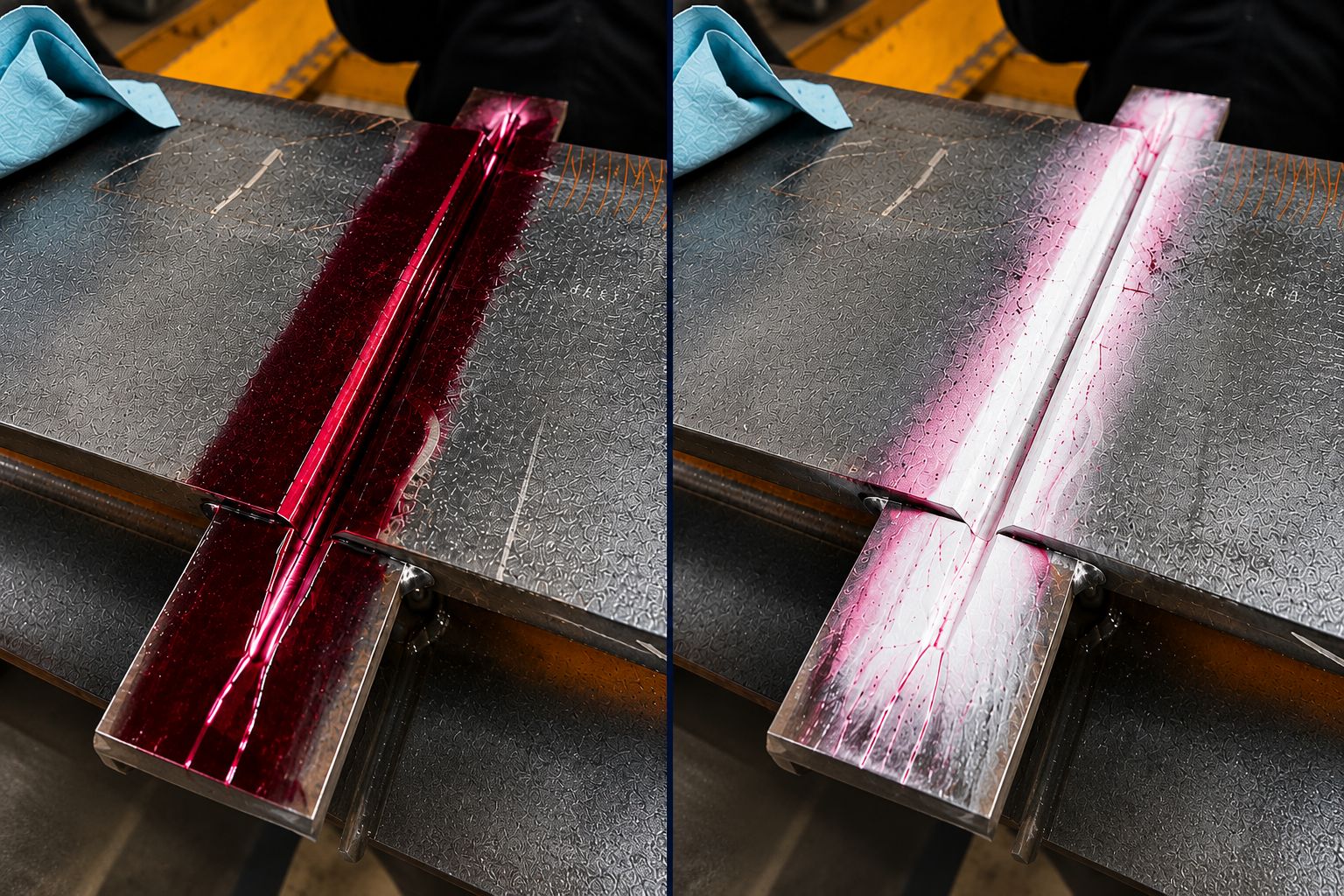

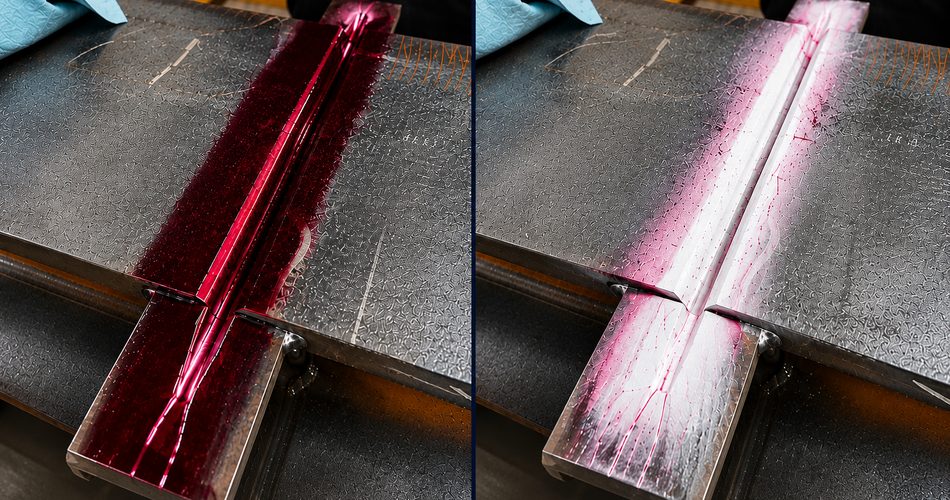
Penetrant testing (liquid penetrant testing) is a non-destructive testing method used to detect surface-breaking defects in materials. To reveal micro-cracks, voids and other surface discontinuities, a colour-contrast or fluorescent liquid penetrant is applied to the surface. The penetrant is drawn into open surface defects, which become visible once the developer has been applied.
The great advantage of penetrant testing is that it reveals micro-cracks, pinholes and porosity invisible to the naked eye without impairing the integrity of the material.
Penetrant Testing Standards
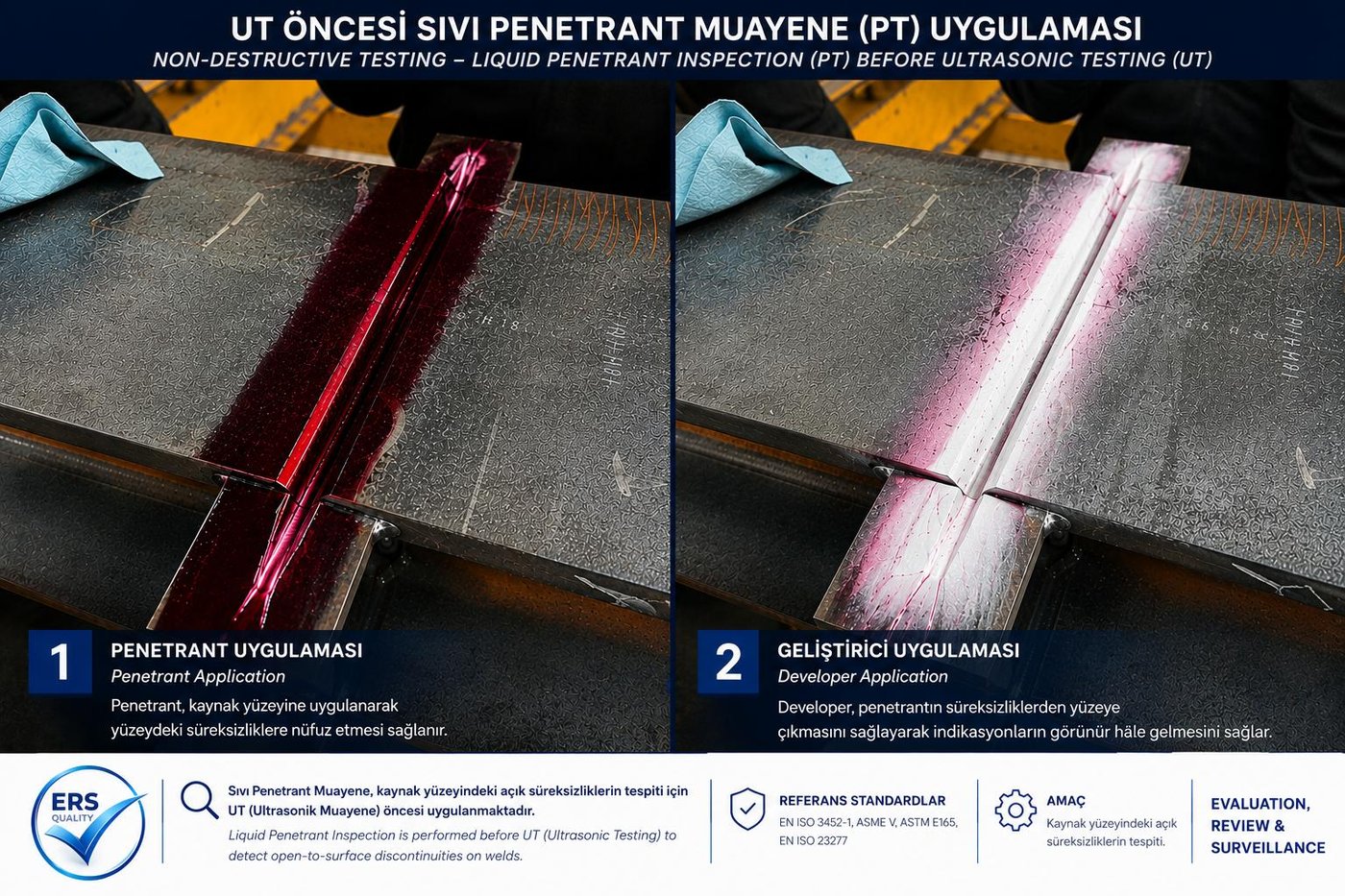
- ISO 3452-1: Sets out the general principles for liquid penetrant testing.
- ASTM E165: Standard practice for liquid penetrant examination.
- ASME BPVC Section V: Defines the requirements for performing liquid penetrant examination on pressure vessels and piping.
These standards specify the correct test procedure and the quality of the testing products used.
How Is Liquid Penetrant Testing Performed?
- 01Pre-cleaning
Dirt, grease and rust are removed from the surface; inadequately cleaned surfaces compromise the reliability of the test.
- 02Penetrant application
A colour-contrast or fluorescent penetrant is applied to the surface and seeps into any discontinuities.
- 03Dwell time
The penetrant is left on the surface for a dwell time determined by the penetrant type and the material properties.
- 04Excess penetrant removal
Excess penetrant is removed from the surface, while the liquid that has entered the defects stays in place.
- 05Developer application
The developer draws the penetrant back out of the defects, producing visible indications.
- 06Inspection and evaluation
The surface is examined under suitable lighting (UV-A light for fluorescent penetrants) and the indications are evaluated.
Fields of Application
- Aerospace industry: Safety-critical testing of aircraft engine and structural components.
- Automotive industry: Detection of micro-cracks and surface defects in vehicle parts.
- Oil and gas industry: Inspection of pipelines, tanks and equipment, particularly at sealing points.
- Construction industry: Testing of structural members subjected to high stresses.
- Iron, steel and metal industry: Detection of surface defects in metal components.
Advantages of Penetrant Testing
- Fast and economical, with lower costs than other methods.
- Detects even very small cracks and defects with high sensitivity.
- Non-destructive: the part remains fit for use.
- Easily applied on site or in the workshop with portable equipment.
- Suitable for metals, plastics, ceramics and composites.
Penetrant testing is an important tool for ensuring safety and quality in industrial production. Its ability to detect surface defects with high sensitivity makes it a critical test method, especially where safety requirements are stringent. When performed correctly and in accordance with the relevant standards, liquid penetrant testing delivers reliable results in assessing material quality.
At ERS KALİTE we provide non-destructive testing services performed by personnel qualified to EN ISO 9712. With our expert team and state-of-the-art equipment, we deliver high-quality, reliable solutions tailored to your industrial needs. Penetrant testing is one of the most effective ways to verify the safety, durability and compliance of your materials and equipment.